
Here are some better caps of the new Hyrda Logo.
(Click to enlarge)

There are a couple of relevent reference of Hyrda.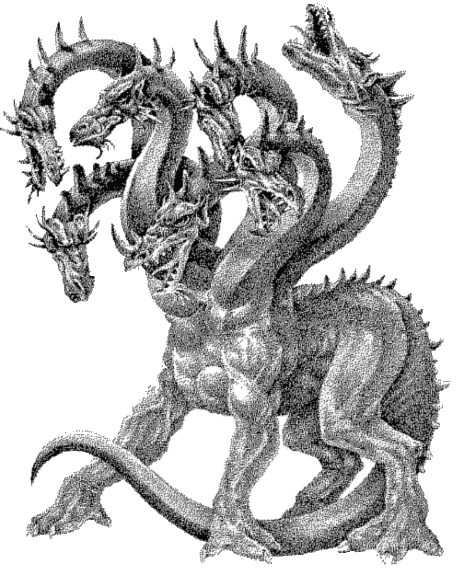 In Greek mythology, the Lernaean Hydra was an ancient nameless serpent-like chthonic water beast that possessed numerous heads—the poets mention more heads than the vase-painters could paint—and poisonous breath (Hyginus, 30). The Hydra of Lerna was killed by Heracles as one of his Twelve Labours. Its lair was the lake of Lerna in the Argolid, though archaeology has borne out the myth that the sacred site was older even than the Mycenaean city of Argos, for Lerna was the site of the myth of the Danaids. Beneath the waters was an entrance to the Underworld, and the Hydra was its guardian
The Hydra was the offspring of Typhon and Echidna, noisome creatures of the Goddess who became Hera. It was said to be the sibling of the Nemean Lion, the Chimaera and Cerberus. As such, it was said to have been chosen as a task for Heracles so that Heracles would probably die.
Source: WIKI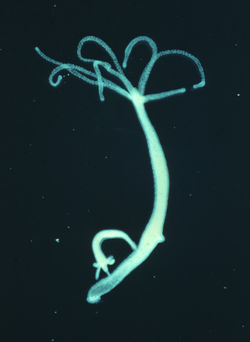 Hydra is a genus of simple, fresh-water animals possessing radial symmetry. Hydras are predatory animals belonging to the phylum Cnidaria and the class Hydrozoa. They can be found in most un-polluted freshwater ponds, lakes and streams in the temperate and tropical regions by gently sweeping a collecting net through weedy areas. They are usually a few milimeters long and are best studied with a microscope. Biologists are especially interested in hydra due to their regenerative powers.
Source: WIKI